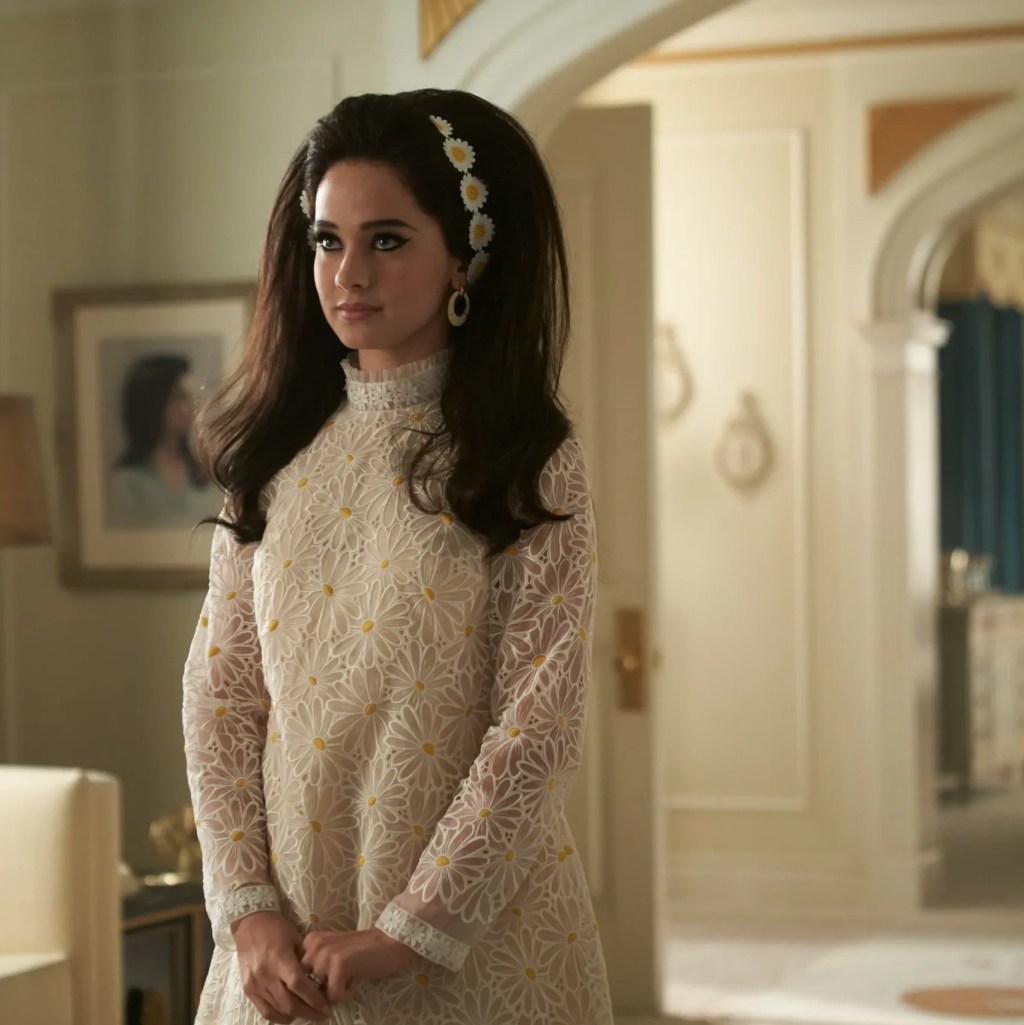
I recently saw that Sofia Coppola is 52 years old. As an author, director, and creator of a wine brand, having done what she has done, no matter how nepobaby it is called, seems incredible. I have always loved the subtext that his films have beneath all those pastel tones and silk lights. However, it does not appear in Priscilla. Having seen Elvis (2022) so recently, I already knew roughly his relationship with the singer, which made the film grey for me.
The evolution seems very obvious: flat and contained. That’s the word: contained.
Although it is based on Priscilla’s autobiography, it is a story written some time ago when Priscilla Presley still had to keep specific passages and feelings from her personal life to herself.
The film could have been a perfect canvas to reveal new passages and have another perspective than that of someone who «seemed» to be mistreated but who was lost along the way. Although it is shown that the violence he was under was mostly psychological, it is still all repetitive strokes of everything he experienced and becomes insipid.
Cailee Spaeny is an angel, and Jacob Elordi, the egomaniac Elvis, is also shown (he can deliver many other emotions, though being a super fan of Euphoria and having already watched Saltburn and even The Kissing Booth, I might be biased). Great chemistry between the leads but little substance.
That melancholy so characteristic of Sofía’s films, palpable in The Virgin Suicides, Somewhere and super punctual in Lost in Translation, is diluted in Priscilla. The contrast between the beauty of Priscilla’s world – starting with her – never ceases to impact.
Why is it that if we assume that we know what Elvis did in Germany, we also assume that we understand what Priscilla did after Elvis? And if this movie is not about Elvis and is about Priscilla, why do they spend two hours just talking about her relationship with him and not how she was able to get away from him?
The purpose of letting the side of this story be seen through her point of view not by Elvis or his biographers is valid, but among all the built fantasy where is that empathy that we manage to have in cinema when we feel close to a reality, no matter how fictitious it may be ? Well, it’s not here, at least not for me.
FR – oui, j’essaie !
J’ai vu récemment que Sofia Coppola a 52 ans. En tant qu’artiste, réalisatrice et propiétaire d’une marque de vin, avoir fait ce qu’elle a fait -peu importe que certains l’appelle nepobaby – me semble incroyable. J’ai toujours aimé le sous-texte que ses films ont sous tous ces tons pastel et ces lumières de rêve. Tout ça, il n’apparaît pas dans Priscilla. Car j’ai vu Elvis (2022) si récemment, je connaissais déjà à peu près sa relation avec le chanteur, ce qui a rendu le film gris pour moi.
L’évolution semble très évidente : plate et contenue. C’est le mot : contenue.
Même basée sur l’autobiographie officielle de Priscilla, il s’agit d’une histoire écrite il y a quelque temps, alors que Priscilla Presley – peut-être – devait encore garder pour elle des passages et des sentiments spécifiques de sa vie personnelle. Le film aurait pu être une toile parfaite pour révéler de nouveaux passages et avoir une autre perspective que celle de quelqu’un qui «semblait» maltraité mais que jamais l’affirme avec plus de sincerité dans le film.
La violence qu’elle a subie était principalement psychologique, mais, le film est rempli de juste une suite de coups répétitifs de tout ce qu’elle a vécu et devient insipide.
Cailee Spaeny est un ange, et Jacob Elordi, l’égocentrique Elvis, est également bien représenté (il peut délivrer bien d’autres émotions, même si étant un super fan d’Euphoria et ayant déjà regardé Saltburn et même The Kissing Booth, je pourrais pas être partial à 100%). Excellente empathie entre les protagonistes mais peu de substance.
Cette mélancolie si caractéristique des films de Sofia, palpable dans The Virgin Suicides, Somewhere et super ponctuelle dans Lost in Translation, est diluée dans Priscilla. Le contraste entre la beauté du monde de Priscilla – à commencer par son physique- ne arrive pas à avoir un impact.
Pourquoi, si nous supposons que nous savons ce qu’Elvis a fait en Allemagne, nous supposons également que nous comprenons ce que Priscilla a fait après Elvis ? Et si ce film ne parle pas d’Elvis mais de Priscilla, pourquoi passent-ils deux heures à parler uniquement de sa relation avec lui et non de la façon dont elle a pu finalement s’éloigner de lui ?
Le but de laisser le côté de cette histoire être vu par elle et non par Elvis ou ses biographes est valable, mais peut-être que parmi la fantaisie, où est cette empathie que l’on parvient à avoir au cinéma quand on se sent proche de la réalité, aussi fictive soit-elle ? Eh bien, ce n’est pas ici, du moins pour moi.
 La Vie Not Rose
Deja un comentario